
 +86 13505025697



How Should Converting Plants Choose Between Heavy-Duty Manual Band Saws and Fully Automatic Paper Roll Slitter Rewinder?
November 28, 2026
Converting plants choose between heavy-duty manual band saws and fully automatic log saws based on batch volume, roll diameter flexibility, and labor budgets. Heavy-duty manual band saws fit low-volume specialty runs, custom jumbo widths, and frequent format changes with low capital outlay. Fully automatic log saws suit continuous, high-speed converting lines that require tight length tolerances, automated feeding, and minimal manual handling. For instance, a converter producing small batches of industrial non-woven wipers or custom-width medical rolls benefits from the quick setup of a band saw, while a plant running continuous retail kitchen towels needs a high-speed orbital log saw to avoid downstream bottlenecks.
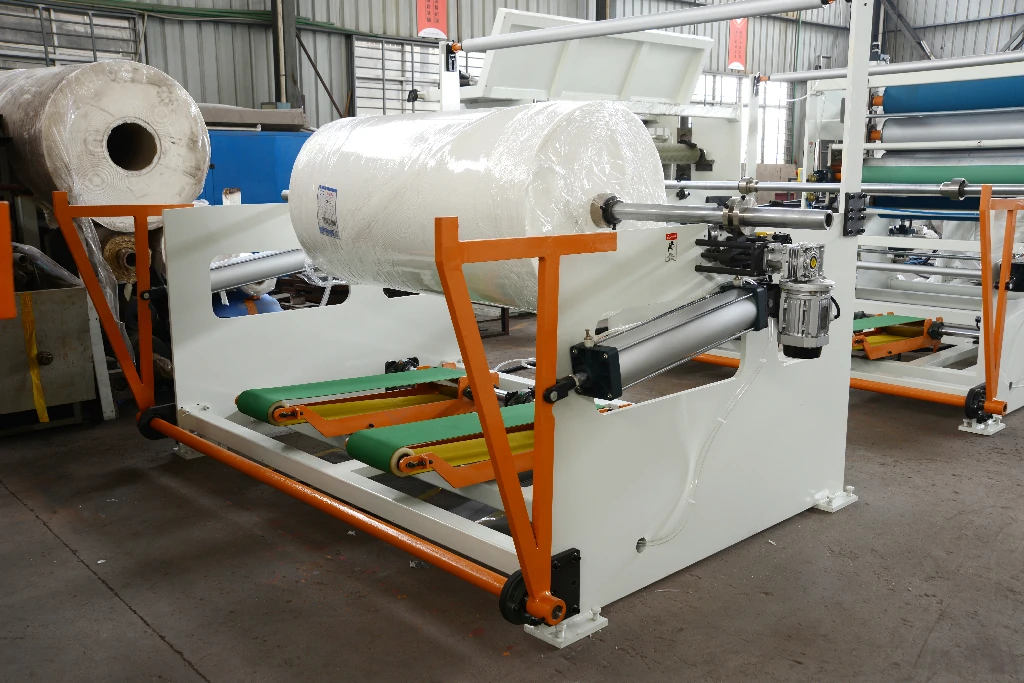
Mechanical Design and Cutting Principles in Specialty Roll Converting
Specialty paper and non-woven rolls vary widely in density, core thickness, and outer diameter. Matching the cutting mechanism to the substrate structure prevents crushed cores, frayed edges, and unspooled outer plies.
How Heavy-Duty Manual Band Saws Operate
Heavy-duty band saws use a continuous toothed or scalloped steel blade running across two balanced drive wheels. An operator places the paper log onto a sliding carriage or cradle, aligns the cut mark against a mechanical backstop, and pushes the log past the vertical blade.
- Open throat clearance: Deep throat frames accommodate oversized roll diameters and irregular lengths that standard enclosed log channels cannot accept.
- Operator-controlled feed speed: Technicians modulate push pressure manually when cutting dense, laminated, or resin-treated papers to prevent blade binding.
- Simple mechanical drive: Fewer servo axes and pneumatic actuators keep routine upkeep straightforward for small maintenance teams.
How Fully Automatic Log Saws Operate
Fully automatic log saws use a high-speed circular or orbital blade paired with programmable servo conveyors and contoured clamping jaws. Logs feed automatically from an accumulator or rewinder discharge into the cutting lane, where clamps stabilize the roll before each slice.
- Closed-loop servo indexing: Programmable logic controllers advance logs to exact length increments (
±0.5 mm) across multi-hour runs. - Automated blade dressing: Built-in grinding stones sharpen the circular blade at set cycle intervals without stopping production.
- Synchronized clamping: Dual-side clamps hold soft or multi-ply logs firmly without ovalizing the cross-section.
Production Throughput, Flexibility, and Format Changeovers
Specialty converters often balance two competing demands: fast changeovers for short custom orders and steady throughput for recurring contracts. Evaluating daily roll volume alongside SKU count clarifies which machine architecture delivers better line balance.
Managing Short Runs and Custom Widths
Manual band saws excel when plants process dozens of distinct roll widths in a single shift. Adjusting the backstop takes seconds, and operators do not need to reprogram servo recipes or swap contoured clamp inserts.
Facilities converting niche substrates—such as oiled industrial wipes, coated release liners, or thick non-woven rolls—frequently pair a heavy-duty band saw with a paper slitting machine to handle bespoke order sizes without tying up main automated lines.
Scaling Continuous High-Speed Output
Fully automatic log saws deliver cutting rates between 120 and 300+ cuts per minute depending on lane count and roll diameter. When an upstream rewinder runs continuously, manual sawing quickly becomes a severe bottleneck that forces upstream equipment to pause.
High-output facilities producing specialty folded or rolled goods—including custom lotion-treated rolls or heavy-duty wipers—rely on automated cutting to keep pace with upstream converting units such as a paper lotion coating machine. Automated discharge conveyors then feed finished rolls directly into downstream wrappers without manual lifting.
Cut Quality, Core Integrity, and Material Waste Control
Specialty paper products often command higher per-roll margins than standard bath tissue, making scrap reduction and clean edge geometry critical to profitability.
Edge Finish and Dust Generation
Band saw blades feature a wider kerf and continuous unidirectional tooth travel. On soft or loosely wound logs, band saw teeth can pull surface fibers, generate higher paper dust, and leave subtle witness marks along the cut face. Dense paperboard cores and hard-wound industrial rolls, however, slice cleanly under steady manual feed.
Circular blades on automatic log saws spin at high peripheral speeds with thin, bevel-ground edges. High blade velocity severs delicate cellulose and non-woven fibers cleanly in milliseconds, minimizing dust and preventing telescoping on soft rolls.
End-Trim Accuracy and Scrap Rates
Manual positioning relies on operator consistency. Small variations in backstop alignment or push angle can create slight taper across wide logs or uneven end-trim offcuts.
Automatic log saws execute programmable end-trim cycles that remove exact scrap allowances from both log tips. Integrated vacuum extraction hoods capture trim strips and fine dust immediately at the cut plane, keeping finished rolls clean for medical, food-service, or cleanroom packaging.
Need assistance selecting the right cutting configuration for your specialty roll dimensions and daily output? Contact Huaxun today to discuss tailored converting specifications with our engineering team.
Cost Structure, Floor Space, and Operator Safety
Capital budgeting for roll cutting equipment involves weighing upfront purchase price against ongoing labor, floor footprint, and workplace safety compliance.
Capital Outlay and Labor Allocation
Heavy-duty manual band saws require significantly lower initial capital investment and minimal compressed air or high-voltage infrastructure. However, they dedicate at least one full-time operator per shift to load logs, execute cuts, and clear finished rolls.
Fully automatic log saws demand higher upfront capital and wider installation footprints to house infeed accumulators, safety guarding, and discharge conveyors. Over multi-year operation in medium-to-high volume plants, reduced labor per ton and lower scrap rates offset the initial equipment cost.
Workplace Safety and Guarding Standards
Manual band saws expose operators to moving blades near the cutting zone, requiring strict adherence to push-block procedures, blade guards, and emergency stop protocols.
Automatic log saws enclose the cutting head inside interlocked safety housings. Light curtains and safety switches halt blade rotation and servo motion immediately if an operator opens an access door, lowering injury risk during high-speed shifts.
Technical Comparison: Manual Band Saws vs. Automatic Log Saws
Table: Operational and Technical Comparison of Specialty Roll Cutting Systems
| Evaluation Criterion | Heavy-Duty Manual Band Saw | Fully Automatic Log Saw |
| Typical Output Rate | 10 to 30 cuts per minute (operator dependent) | 120 to 300+ cuts per minute |
| Roll Diameter Flexibility | High; open throat handles oversized or varied diameters | Moderate; bounded by clamp jaw and channel range |
| Format Changeover Time | Under 1 minute via mechanical backstop | 5 to 15 minutes via HMI recipe and clamp adjustment |
| Cut Face Quality | Good on dense rolls; higher dust on soft tissue | Clean, low-dust slice across soft and dense substrates |
| Length Tolerance | ±1.5 mm to ±3.0 mm | ±0.3 mm to ±0.5 mm |
| Operator Requirement | Continuous manual feeding and unloading | Periodic supervision and blade/grinding checks |
| Initial Capital Cost | Low to moderate | Moderate to high |
Decision Framework for Specialty Paper Converters
Plant engineers can apply a clear set of operational thresholds before finalizing equipment procurement:
- Audit daily cut volume: If daily output stays below 3,000 finished rolls with frequent width changes, a heavy-duty manual band saw preserves capital and agility. Above 8,000 rolls per shift, an automatic log saw prevents labor bottlenecks.
- Map diameter and core ranges: Measure the minimum and maximum outer diameters across all SKUs. Wide diameter swings favor band saws unless the automatic saw includes quick-change contoured clamps.
- Evaluate substrate softness: Soft, low-density, or embossed multi-ply rolls deform easily under manual band sawing and benefit from synchronized servo clamping.
- Check downstream packaging integration: Lines feeding automated multi-roll bundlers or flow wrappers require the consistent spacing and square edges that automatic log saws provide.
- Calculate total labor and scrap cost: Compare three-year operator wages plus trim waste against the amortized cost of an automated cutting station.
For integrated specialty lines combining embossing, lamination, and precision roll finishing, pairing upstream converting equipment with a hand towel making machine or dedicated roll cutter ensures balanced throughput from jumbo parent roll to packed carton.
Frequently Asked Questions
Can a heavy-duty band saw cut soft multi-ply tissue logs without crushing them?
Heavy-duty band saws can cut soft logs if fitted with a fine scalloped blade and a contoured V-cradle, though feed speed must remain slow. High-speed automatic log saws deliver cleaner edges and higher throughput on soft multi-ply tissue.
What blade type works best for cutting dense specialty paper cores?
Bi-metal or carbide-tipped scalloped band blades handle thick paperboard cores and dense industrial rolls without rapid tooth dulling. On automatic log saws, alloy steel circular blades with automated grinding stones maintain sharp cutting edges across dense substrates.
How much floor space does an automatic log saw require compared to a band saw?
A standalone heavy-duty band saw typically occupies under 4 square meters of floor space. An automatic log saw with log accumulation and discharge conveyors generally requires 15 to 25 square meters depending on lane configuration and log length.
Huaxun: Comprehensive Solutions for Paper Converting Lines
Quanzhou Huaxun Machinery Making Co., Ltd., established in 2009, designs, researches, manufactures, and sells household and specialty paper processing equipment worldwide. Huaxun offers toilet paper, kitchen towel, facial tissue, napkin, and hand towel production lines alongside slitting, core winding, lotion coating, laminating embossing, and packing machinery built to ISO 9001 and CE standards. Visit Huaxun to explore customized machinery configurations tailored to your production requirements.
References
- International Organization for Standardization. ISO 9001 Quality Management Systems Requirements. ISO Website
- European Commission. Machinery Directive and CE Marking Compliance Guidelines. European Union Law
- Technical Association of the Pulp and Paper Industry. Tissue Converting and Finishing Standards. TAPPI Website
- Occupational Safety and Health Administration. Machine Guarding Standards for Band Saws and Cutting Equipment. OSHA Website

